
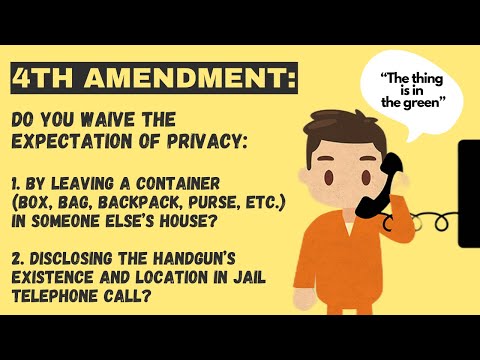
“The Fourth Amendment is a vital safeguard of the right of the citizen to be free from unreasonable governmental intrusions into any area in which he has a reasonable expectation of privacy.” Winston v. Lee, 470 U.S. 753, 767, 105 S.Ct. 1611, 84 L.Ed.2d 662 (1985) (citations omitted). As the parties agree, Monghur, at least initially, held a reasonable expectation of privacy in the closed container that he stored in the closet in Wilson’s apartment. See United States v. Davis, 332 F.3d 1163, 1167 (9th Cir. 2003) (“`A person has an expectation of privacy in his or her private, closed containers’ and `does not forfeit that expectation of privacy merely because the container is located in a place that is not controlled exclusively by the container’s owner.’” (quoting United States v. Fultz, 146 F.3d 1102, 1105 (9th Cir. 1998))). The only question raised by this appeal is whether Monghur relinquished, abandoned, or otherwise waived that expectation of privacy by disclosing the handgun’s existence and location in jail telephone conversations that he knew were monitored by law enforcement.
When made to a law enforcement officer, an unequivocal, contemporaneous, and voluntary disclosure that a package or container contains contraband waives any reasonable expectation of privacy in the contents. See Pennsylvania v. Mimms, 434 U.S. 106, 108-09, 98 S.Ct. 330, 54 L.Ed.2d 331 (1977) (recognizing that “reasonableness” remains the touchstone under the Fourth Amendment).
Nothing about his jailhouse conversations with Bousley, which law enforcement later overheard, operates as a “direct and explicit” waiver of an expectation of privacy in a container hidden elsewhere. Cardona-Rivera, 904 F.2d at 1156. Monghur’s efforts to conceal the subject matter based on what he said on the phone demonstrate both an objective and subjective intention to preserve privacy — not to relinquish it. We therefore reject the Government’s position that Monghur waived his expectation of privacy in the closed container through his statements on the telephone.
To be clear, we think based on his admissions in the jail telephone conversations, coupled with Monghur’s criminal record for violence and what officers discovered when Wilson invited them to look around, Agent McCamey had probable cause to believe Monghur had a firearm stashed inside Wilson’s apartment. Exigency was not established here and is unchallenged on appeal. Therefore, we must presume that, after discovering Monghur’s possessions in the closet and identifying the green plastic container (i.e., what they reasonably believed was “the green”), agents could have sealed the apartment and presented their observations from the investigation, Monghur’s known criminal history, and Monghur’s conversations with Bousley to a neutral and detached magistrate to support a warrant application. But, we find no basis to conclude that Monghur waived his expectation of privacy in the closed container because he made an encrypted, incriminating disclosure that he was warned would be reviewed by law enforcement. Accordingly, the agents’ search of his closed container without a warrant violated Monghur’s Fourth Amendment rights.
Full case here: U.S. v. Monghur, 588 F.3d 975, 978-79 (9th Cir. 2009), https://casetext.com/case/us-v-monghur-3
Filed under: 4th Amendment & Searches · Federal Crimes

Anton Vialtsin, Esq., E.I. is a San Diego criminal defense attorney and CJA Panel member in the Southern and Central Districts of California. New case breakdowns every Wednesday on YouTube.
Related articles
- FLOCK CAMERA Searches Violate the 4th Amendment; Federal Judge Throws Out ALL Evidence!October 7, 2026 · ▶ Video
- Can Cops Use a Thermal Camera on Your Home Without a Warrant? | Kyllo v. USJuly 22, 2026 · ▶ Video
- “He Put Stuff in My Room, Bro” — Kid Destroys 4th Amendment Defense (US v. Gatkuoth)June 10, 2026 · ▶ Video
- FBI Raids Home, Refuses to Show Warrant — State Can’t Just Take the Feds’ Word for It. 4th AmendmentJune 3, 2026 · ▶ Video