
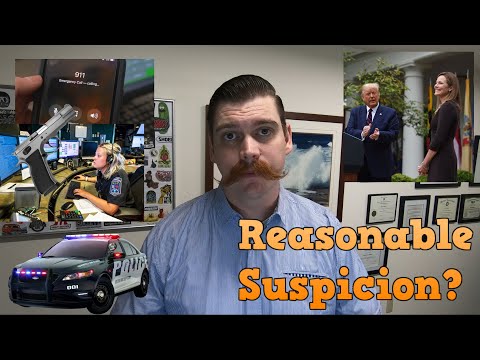
Hon. Amy Coney Barrett is the front-runner to be nominated to the Supreme Court. Let’s examine a criminal law and Fourth Amendment case authored by her in the 7th Circuit.
The case is United States v. Watson, 900 F.3d 892 (7th Cir. 2018). The police responded to a 911 call from a 14-year-old who borrowed a stranger’s phone and reported seeing “boys” “playing with guns” near a “gray and greenish Charger.” Officers blocked the vehicle and frisked the occupants, leading to the discovery of firearms. Watson was charged under 18 U.S.C. § 922(g)(1) and moved to suppress the evidence.
Watson argued the stop was unlawful because the anonymous tip did not provide reasonable suspicion. The government cited Navarette v. California, 572 U.S. 393 to argue the tip was reliable.
The Fourth Amendment requires reasonable suspicion to stop someone for potential criminal activity (Terry v. Ohio, 392 U.S. 1). Anonymous tips alone rarely suffice (Florida v. J.L., 529 U.S. 266), but certain factors, such as eyewitness knowledge, contemporaneous reporting, and use of 911, may increase reliability (Navarette, 134 S.Ct. 1683).
In Watson, the tip did not justify immediate seizure, highlighting nuances in Fourth Amendment law.
Full opinion here: https://casetext.com/case/united-states-v-watson-250
If you are facing criminal charges in San Diego or nearby, San Diego Criminal Defense Attorney Anton Vialtsin can help protect your rights and aggressively defend your case.
Anton Vialtsin, Esq.
LAWSTACHE™ LAW FIRM | Criminal Defense & Business Law
185 West F Street Suite 100-D
San Diego, CA 92101
(619) 357-6677
https://lawstache.com
Licensed in California, Nevada, and Federal Courts. Serving San Diego clients with experienced criminal defense representation.
Filed under: 4th Amendment & Searches · Federal Crimes · Guns & 2nd Amendment

Anton Vialtsin, Esq., E.I. is a San Diego criminal defense attorney and CJA Panel member in the Southern and Central Districts of California. New case breakdowns every Wednesday on YouTube.
Related articles
- “He Put Stuff in My Room, Bro” — Kid Destroys 4th Amendment Defense (US v. Gatkuoth)June 10, 2026 · ▶ Video
- Felon in Possession Unconstitutional, Right to Protest, and Cryptocurrency, own casesAugust 30, 2024 · ▶ Video
- Police aimed his gun at her nose, told her to freeze, and detained: ARREST and NOT a “Terry Stop.”August 30, 2024 · ▶ Video
- Police “secured” the home & didn’t let the husband back inside after suspicious death of his wifeAugust 22, 2024 · ▶ Video